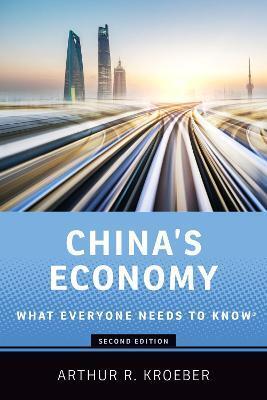
China's Economy
Oxford University Press Inc,
Arthur R. (Founding partner and managing director of Gavekal Dragonomics) Kroeber
Knihu kúpite v
2 e-shopoch
od
14,20 €
Ak sa vám po kliknutí na tlačidlo "Do obchodu" nezobrazí stránka knihy vo vybranom e-shope, je potrebné vypnúť AdBlock vo vašom prehliadači pre našu stránku.
Návod na vypnutie je napríklad na adrese https://www.sme.sk/dok/20466299/ako-vypnut-adblock-na-sme-sk-whitelist.
Krátky popis
China's economic growth has been revolutionary, and is the
foundation of its increasingly prominent role in world affairs. It
is the world's second biggest economy, the largest manufacturing
and trading nation, the consumer of half the world's steel and
coal, the biggest source of international tourists, and one of the
most influential investors in developing countries from southeast
Asia to Africa to Latin America. Multinational companies make
billions of dollars inprofits in China each year, while traders
around the world shudder at every gyration of the country's unruly
stock markets.Perhaps paradoxically, its capitalist economy is
governed by an authoritarian Communist Party that shows no sign of
loosening its grip. China is frequently in the news, whether
because of trade disputes, the challenges of its Belt and Road
initiative for global infrastructure, or its increasing military
strength. China's political and technological challenges, created
by a country whose political system and values differ dramatically
from most of the other major world economies, creates uncertainty
and even fear.China's Economy: What Everyone Needs to Know is a
concise introduction to the most astonishing economic and political
story of the last three decades. Arthur Kroeber enhances our
understanding of China's changes and their implications. Among the
essential questions he answers are: How did China grow so fast for
so long? Can it keep growing and still solve its problems of
environmental damage, fast-rising debt and rampant corruption? How
long can its vibrant economy co-exist with therepressive one-party
state? How do China's changes affect the rest of the world? This
thoroughly revised and updated second edition includes a
comprehensive discussion of the origins and development of the
US-China strategic rivalry, including Trump's trade war and the
race for technological supremacy.It also explores the recent
changes in China's political system, reflecting Xi Jinping's
emergence as the most powerful leader since Mao Zedong. It includes
insights on changes in China's financial sector, covering the rise
and fall of the shadow banking sector, and China'sincreasing
integration with global financial markets. And it covers China's
rapid technological development and the rise of its global Internet
champions such as Alibaba and Tencent.
Vývoj ceny
Aktuálna Ø cena knihy China's Economy je 14,45 €
Výber kníh autorov
Oxford University Press Inc ,
Arthur R. (Founding partner and managing director of Gavekal Dragonomics) Kroeber




Zobraziť všetky knihy autora
Oxford University Press Inc,
Arthur R. (Founding partner and managing director of Gavekal Dragonomics) Kroeber
Výber kníh vydavateľa
Oxford


Zobraziť všetky knihy vydavateľa
Oxford
Naše tipy