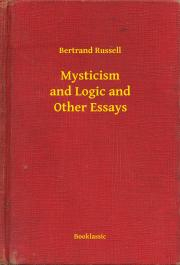
Mysticism and Logic and Other Essays - Bertrand Russell
Knihu kúpite v
1 e-shope
od
0,88 €
Ak sa vám po kliknutí na tlačidlo "Do obchodu" nezobrazí stránka knihy vo vybranom e-shope, je potrebné vypnúť AdBlock vo vašom prehliadači pre našu stránku.
Návod na vypnutie je napríklad na adrese https://www.sme.sk/dok/20466299/ako-vypnut-adblock-na-sme-sk-whitelist.
Krátky popis
The following essays have been written and published at various
times, and my thanks are due to the previous publishers for the
permission to reprint them. The essay on "Mysticism and Logic"
appeared in the Hibbert Journal for July, 1914. "The Place of
Science in a Liberal Education" appeared in two numbers of The New
Statesman, May 24 and 31, 1913. "The Free Man's Worship" and "The
Study of Mathematics" were included in a former collection (now out
of print), Philosophical Essays, also published by Messrs.
Longmans, Green & Co. Both were written in 1902; the first appeared
originally in the Independent Review for 1903, the second in the
New Quarterly, November, 1907. In theoretical Ethics, the position
advocated in "The Free Man's Worship" is not quite identical with
that which I hold now: I feel less convinced than I did then of the
objectivity of good and evil. But the general attitude towards life
which is suggested in that essay still seems to me, in the main,
the one which must be adopted in times of stress and difficulty by
those who have no dogmatic religious beliefs, if inward defeat is
to be avoided. The essay on "Mathematics and the Metaphysicians"
was written in 1901, and appeared in an American magazine, The
International Monthly, under the title "Recent Work in the
Philosophy of Mathematics." Some pointsin this essay require
modification in view of later work. These are indicated in
footnotes. Its tone is partly explained by the fact that the editor
begged me to make the article "as romantic as possible." All the
above essays are entirely popular, but those that follow are
somewhat more technical. "On Scientific Method in Philosophy" was
the Herbert Spencer lecture at Oxford in 1914, and was published by
the Clarendon Press, which has kindly allowed me to include it in
this collection. "The Ultimate Constituents of Matter" was an
address to the Manchester Philosophical Society, early in 1915, and
was published in the Monist in July of that year. The essay on "The
Relation of Sense-data to Physics" was written in January, 1914,
and first appeared in No. 4 of that year's volume of Scientia, an
International Review of Scientific Synthesis, edited by M. Eugenio
Rignano, published monthly by Messrs. Williams and Norgate, London,
Nicola Zanichelli, Bologna, and Félix Alcan, Paris. The essay "On
the Notion of Cause" was the presidential address to the
Aristotelian Society in November, 1912, and was published in their
Proceedings for 1912-13. "Knowledge by Acquaintance and Knowledge
by Description" was also a paper read before the Aristotelian
Society, and published in their Proceedings for 1910-11.
Vývoj ceny
Aktuálna Ø cena knihy Mysticism and Logic and Other Essays - Bertrand Russell je 0,88 €
Výber kníh autora
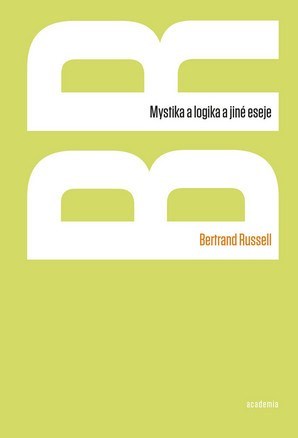
Bertrand Russell

Zobraziť všetky knihy autora
Bertrand Russell
Výber kníh vydavateľa
Booklassic
Zobraziť všetky knihy vydavateľa
Booklassic
Naše tipy