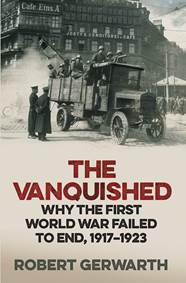
The Vanquished : Why the First World War Failed to End, 1917-1923
Knihu kúpite v
1 e-shope
od
27,08 €
Ak sa vám po kliknutí na tlačidlo "Do obchodu" nezobrazí stránka knihy vo vybranom e-shope, je potrebné vypnúť AdBlock vo vašom prehliadači pre našu stránku.
Návod na vypnutie je napríklad na adrese https://www.sme.sk/dok/20466299/ako-vypnut-adblock-na-sme-sk-whitelist.
Krátky popis
Times Literary Supplement BOOKS OF THE YEAR 2016'This narrative of
continent-wide chaos makes it easier to understand why order came
to seem a supremely desirable objective in 1930s Europe, trumping
freedom' Max Hastings, The Sunday Times 'This war is not the end
but the beginning of violence. It is the forge in which the world
will be hammered into new borders and new communities. New molds
want to be filled with blood, and power will be wielded with a hard
fist.' Ernst Jünger (1918)For the Western allies 11 November 1918
has always been a solemn date - the end of fighting which had
destroyed a generation, and also a vindication of a terrible
sacrifice with the total collapse of their principal enemies: the
German Empire, Austria-Hungary and the Ottoman Empire. But for much
of the rest of Europe this was a day with no meaning, as a
continuing, nightmarish series of conflicts engulfed country after
country. In this highly original, gripping book Robert Gerwarth
asks us to think again about the true legacy of the First World
War. In large part it was not the fighting on the Western front
which proved so ruinous to Europe's future, but the devastating
aftermath, as countries on both sides of the original conflict were
wrecked by revolution, pogroms, mass expulsions and further major
military clashes. If the War itself had in most places been a
struggle purely between state-backed soldiers, these new conflicts
were mainly about civilians and paramilitaries, and millions of
people died across central, eastern, and south-eastern Europe
before the USSR and a series of rickety and exhausted small new
states came into being. Everywhere there were vengeful people,
their lives racked by a murderous sense of injustice, and looking
for the opportunity to take retribution against enemies real and
imaginary. Only a decade later, the rise of the Third Reich and
other totalitarian states provided them with the opportunity they
had been looking for.
Výber kníh autorov
Robert Gerwarth ,
Allen Lane



Zobraziť všetky knihy autora
Robert Gerwarth,
Allen Lane
Výber kníh vydavateľa
Slovart
Zobraziť všetky knihy vydavateľa
Slovart
Naše tipy