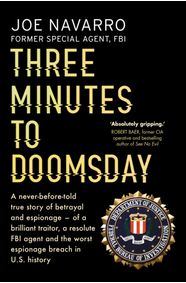
Three Minutes To Doomsday
Knihu kúpite v
1 e-shope
od
17,05 €
Ak sa vám po kliknutí na tlačidlo "Do obchodu" nezobrazí stránka knihy vo vybranom e-shope, je potrebné vypnúť AdBlock vo vašom prehliadači pre našu stránku.
Návod na vypnutie je napríklad na adrese https://www.sme.sk/dok/20466299/ako-vypnut-adblock-na-sme-sk-whitelist.
Krátky popis
It is 1988 and Florida-based FBI agent Joe Navarro divides his time
between SWAT assignments, flying air reconnaissance, and working
counter-intelligence. A body-language expert with an uncanny
ability to “read” those he interrogates, Navarro is known as
super-intense – an agent whose work ethic quickly burns out
partners. He craves an assignment that will get him noticed by the
FBI top brass but then again, as he’ll come to learn: be careful
what you wish for . . . It was while on a routine assignment –
interviewing a ‘person of interest’, a former US soldier named Rod
Ramsay with links to another soldier, Clyde Conrad, recently
arrested in Germany as a traitor – that Navarro thought he smelled
a rat. He noticed a tic in Ramsay's hand when Conrad’s name was
mentioned. Not a lot to go on, but enough for Navarro to insist
that an investigation be opened.What followed was extraordinary –
and unique in the annals of espionage detection - a game of
cat-and-mouse played at the highest level: on one side, an FBI
agent who must not reveal that he suspects his target, on the
other, a traitor, a seller of his country’s secrets, whose weakness
is the thrill he gets from sparring with his inquisitor. To prise
from Ramsay the full extent of the damage he had wrought, Navarro
had to pre-choreograph every interview because Ramsay was
exceptionally intelligent, with the second highest IQ ever recorded
by the U.S. Army. It would become an interrogation that literally
pitted genius against genius – a battle of wits fought against one
of the most turbulent periods of the 20th century – the demise and
eventual collapse of the Eastern Bloc and the Soviet Union - and
the very real possibility that Russia's leaders, in a last
desperate bid to alter history’s trajectory, might engage in
all-out war. As Navarro was to learn over the course of nearly
fifty exhausting and mind-bending interviews and interrogations,
Ramsay had handed the Soviets the knowledge needed to destroy
America and its western allies…In Three Minutes to Doomsday, Joe
Navarro tells this extraordinary story for the first time - a story
of the exposure and breaking of one of the most damaging espionage
rings in US history whose treachery threatened the entire world.
Výber kníh autorov
Navarro Joe ,
Bantam Press

Zobraziť všetky knihy autora
Navarro Joe,
Bantam Press
Výber kníh vydavateľa
Slovart

Zobraziť všetky knihy vydavateľa
Slovart
Naše tipy