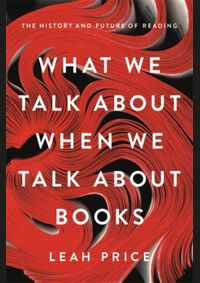
What We Talk About When We Talk About Books
Knihu kúpite v
1 e-shope
od
26,60 €
Ak sa vám po kliknutí na tlačidlo "Do obchodu" nezobrazí stránka knihy vo vybranom e-shope, je potrebné vypnúť AdBlock vo vašom prehliadači pre našu stránku.
Návod na vypnutie je napríklad na adrese https://www.sme.sk/dok/20466299/ako-vypnut-adblock-na-sme-sk-whitelist.
Krátky popis
Around 2000, people began to believe that books were on verge of
extinction. Their obsolescence, in turn, was expected to doom the
habits of mind that longform print had once prompted: the capacity
to follow a demanding idea from start to finish, to look beyond the
day's news, or even just to be alone. The ",death of the book", is
an anxiety that has spawned a thousand jeremiads about the dumbing
down of American culture, the ever-shorter attention spans of our
children, the collapse of civilized discourse.All of these
anxieties rely on the idea of a golden age, when children and
adults alike sat quietly for long stretches reading edifying
literature that improved our minds and souls. A booklover by
temperament as much as profession, literature professor Leah Price
wanted to believe that. But as a historian of the book, searching
out the traces of long-dead readers through their marginalia and
their unbroken spines, she began to wonder if our current digital
discontents were stirring up nostalgia for a past that had never
existed.When you look at old books, what do you find? A few
well-greased pagespreads limply scattered among hundreds that
remained spotlessly crisp, essays stained with beer from reading
aloud at the pub, novels crumpled from being hidden in a pocket.
From the eighteenth-century dawn of mass literacy to the
Cold-War-era triumph of the paperback, few books were read
cover-to-cover, meditatively, in silence. We have been shocked -
shocked!--by data from Kindle that shows that most readers start
books but rarely finish them, or skip large sections in between.But
it has always been so. And in fact, for much of history, ",deep",
reading was strongly discouraged. Doctors and clergymen warned that
print could addict, distract, or corrupt--not the ideas it
contained, but the very experience of running one's eyes over a
page.Over the centuries, children and women especially were
repeatedly warned not to spend too much time reading, lest it
excite their minds and distract them from other, more edifying
tasks. Impatient with untempered book worship, Price emphasizes the
continuities between past and present reading practices, and
dispels the myth of the Golden Age of Print on multiple fronts. An
anti-nostalgic examination of the past, present and future of
reading, What We Talk About When We Talk About Books will fascinate
bibliophiles and readers of all stripes.
Výber kníh autorov
Basic Books ,
Leah Price

Zobraziť všetky knihy autora
Basic Books,
Leah Price
Výber kníh vydavateľa
Slovart

Zobraziť všetky knihy vydavateľa
Slovart
Naše tipy